
MANIFESTO
Why I’m betting against AI (sort of)
You’d be right to be suspicious of a founder who tells you he built the human answer to AI. If Throw had appeared six months after ChatGPT, this essay would be a positioning document. It appeared before. I started building it in the middle of the pandemic — so let me tell you what I was actually betting on, because it wasn’t a technology cycle.
I grew up an introverted kid in Mexico City, more aware than I wanted to be of how groups work: who performs, who watches, what you can’t say out loud. Years later, after a long stretch building real-estate projects and teaching myself how software actually works, the idea that wouldn’t leave me alone was small and specific. There was no place on the internet to ask the question you couldn’t ask anyone you knew — and get an answer from a person who had actually lived it.
That wasn’t AI’s fault. The internet had already done it to itself. Social feeds had turned identity into a facade contest. Question-and-answer sites had turned into point-scoring. Anonymous apps had pointed anonymity at the people you know — your school, your campus — and curdled, one after another. The scarcity I wanted to solve was already here. The pandemic just made everyone feel it at once.
So we built Throw:
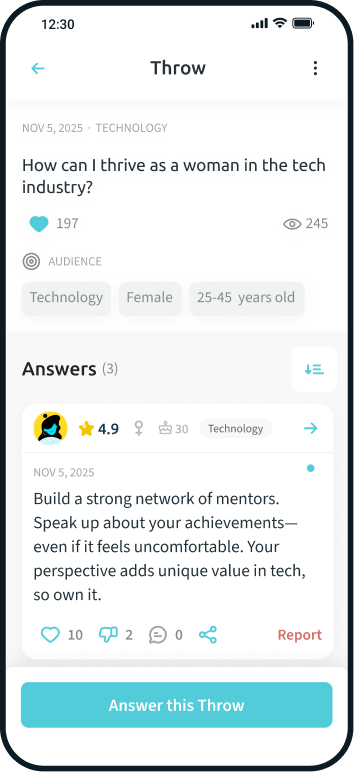
An anonymous Q&A app where you throw a question and it gets routed to strangers who’ve been where you are. There are no real names anywhere — not on questions, not on answers, not in messages. There’s no engagement-ranked feed and no follower counts; standing is earned by being helpful, not popular. And every answer is written by a person. Since 2023, that’s 86,000 and counting.
Here’s the “sort of.” AI is inside Throw. It classifies every question, matches it to people with the right lived experience, and screens for risk before any human sees it. AI routes; humans answer. I’m not against the machines. I’m against pretending they’ve lived anything.
Then generative AI arrived and industrialized the thing I’d been building against. This isn’t a feeling; the numbers are in. Pew Research found that more than a third of web pages published since ChatGPT launched — 35 percent — show significant signs of AI authorship. Cloudflare reported that bot traffic has overtaken human traffic on the web: bots reading pages written by other bots. Spotify removed more than 75 million spammy tracks in a single year while writing new rules for AI music. LinkedIn added a “seems like AI slop” button, and more than a million people clicked it. And Merriam-Webster’s word of the year for 2025 was slop. Every major platform is now building detectors to find the humans in its own product. We skipped the detector and built the human network.
I want to be precise about why, because “humans good, AI bad” is not the argument, and I’d be lying if I made it. AI is astonishing. It answers in a second what used to take a library. It writes working code, reads a scan, drafts the contract, and is starting to help find cures for diseases that have beaten us for a century. I use it every day, inside Throw and out. But it is not a person. It hasn’t sat in the chair, taken the job, ended the marriage, buried the parent. The questions people bring to Throw are the ones whose answers are somebody’s life. Should I take the job? Is it normal that I feel this way about my mother? How do you start over at forty? The value there isn’t information; it’s that a person who’s been there took the time to tell you what it was like. AI can’t give that answer — not because it isn’t powerful, but because it hasn’t lived anything.
The hard part was never the philosophy. It was keeping an all-human place human when bots are free. Detection is a treadmill — the generators improve exactly as fast as the detectors. So we didn’t bet on detection. We bet on incentives. Answering on Throw earns you standing, not money — so there’s nothing for a bot farm to harvest. It’s a mobile-only app, built around the kind of live back-and-forth that machines still fumble. Questions are assigned from the pool of people with the relevant experience — higher reputation first, with a deliberate share held for newcomers so they get their chance. Behave badly and the community reports you, your score drops, and you sink to the back of every queue. And the one place money does flow — paid one-on-one video sessions with people who’ve built real expertise — is a live conversation, which nobody has figured out how to fake. Inside the company, one rule above all others: we never seed a fake answer. Not one, not ever. A single fake would falsify the company.
We’ve also stayed small on purpose. The graveyard of anonymous apps is full of companies that scaled before their safety and their culture could carry the weight. We kept acquisition at a floor while we built the routing, the reputation system, the safety layer — and while we learned what 86,000 real answers had to teach us about what people still ask other people. This relaunch is the moment we open the doors wider. Not because we’re finished; because the human part finally works. One more thing, since I’m a Mexican founder building this for an American audience first. I’ve been traveling to the U.S. my whole life, studied in New York, lived three years in San Diego. But the honest answer is that Throw was never an American-culture product. It’s a human-behavior product. The context is local; the psychology isn’t. And the whole premise of the app is that a stranger outside your bubble can help you — sometimes precisely because they’re outside it. An outsider building the place where strangers help strangers isn’t the contradiction. It’s the product.
I didn’t predict the AI wave, and I won’t pretend I did. I built for a scarcity — real people being real with each other — that every year since has made scarcer. The bet didn’t change. The odds got better
— Luis Amodio, founder, Throw